
Faux Flower Styling
Fall Flower Arrangements That Last the Whole Season
Aug
Autumn is the one season where flower arrangements do the most work. The light drops, the palette outside turns, and a single arrangement on a console table changes how a whole room reads. It is also the season where fresh flowers are least cooperative: chrysanthemums drop petals within a fortnight, dried stems shed onto the sideboard, and anything you bought in September looks tired well before the end of October.
This guide covers how to build fall flower arrangements that hold for the whole season — what to use, how to combine it, and where the usual approaches go wrong.
Why autumn is hard on fresh arrangements
Three things happen at once in autumn homes, and all three work against cut flowers.
Heating comes on. Central heating drops indoor humidity sharply. Cut stems lose water through their petals faster than they can draw it up, and the vase runs dry in half the time it did in summer. A fresh arrangement that lasted ten days in June often gets six in October.
The flowers themselves are short-lived. Garden mums, the defining autumn bloom, hold four to six weeks in the ground but only ten to fourteen days cut. Dahlias are worse. The stems you want most are the ones that fade fastest.
The season is long. Autumn styling runs from early September through to late November — roughly twelve weeks. Covering that with fresh flowers means five or six separate purchases, each one arranged from scratch.
That last point is the one people underestimate. The cost argument for artificial flowers is rarely about a single arrangement. It is about the twelve-week span.
The four stems that carry an autumn arrangement
You do not need variety. Most convincing autumn arrangements use three or four elements, repeated. Adding a fifth usually makes it read as a supermarket bouquet rather than something considered.
1. Mums, for the mass
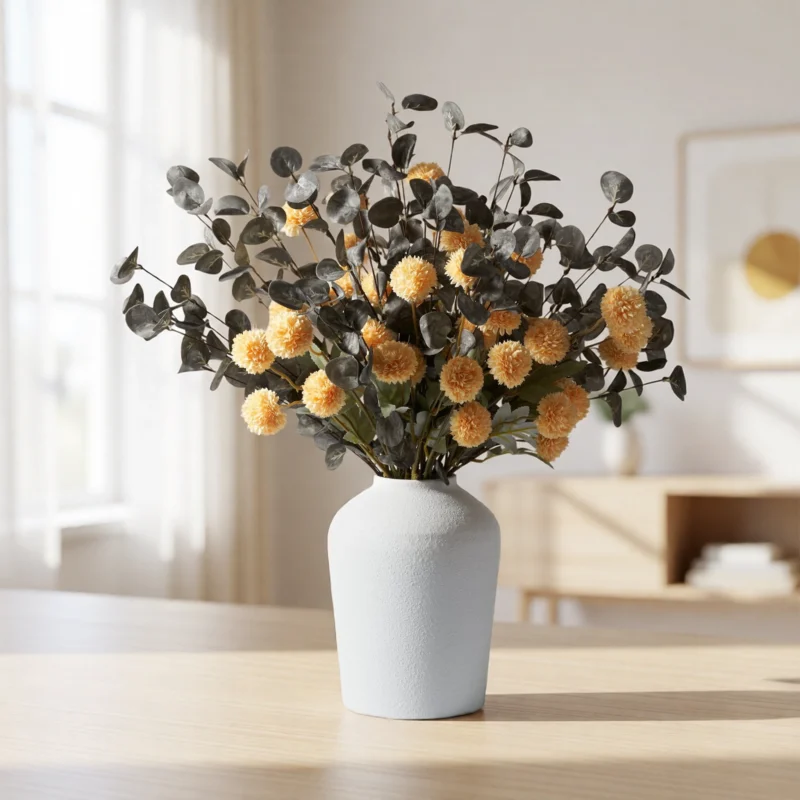
Artificial mums are the workhorse. The dense pom-pom head gives an arrangement its visual weight, and the autumn colour range — rust, brown, cream, deep orange, burgundy — is exactly the palette the season calls for.
The practical advantage of faux here is specific: real mums shed. The outer petals brown first and drop onto whatever surface the vase is on. In a dining room that means picking petals off the table before every meal for two weeks.
Sets sold as ten stems with roughly fifty heads give you enough mass for a large arrangement, or enough to split across two smaller ones. If you are working with a single console table, five stems is usually sufficient.
2. Eucalyptus, for the structure
Mums alone read as a blob. Eucalyptus gives the arrangement its outline — the stems reach past the flower heads and break the silhouette.
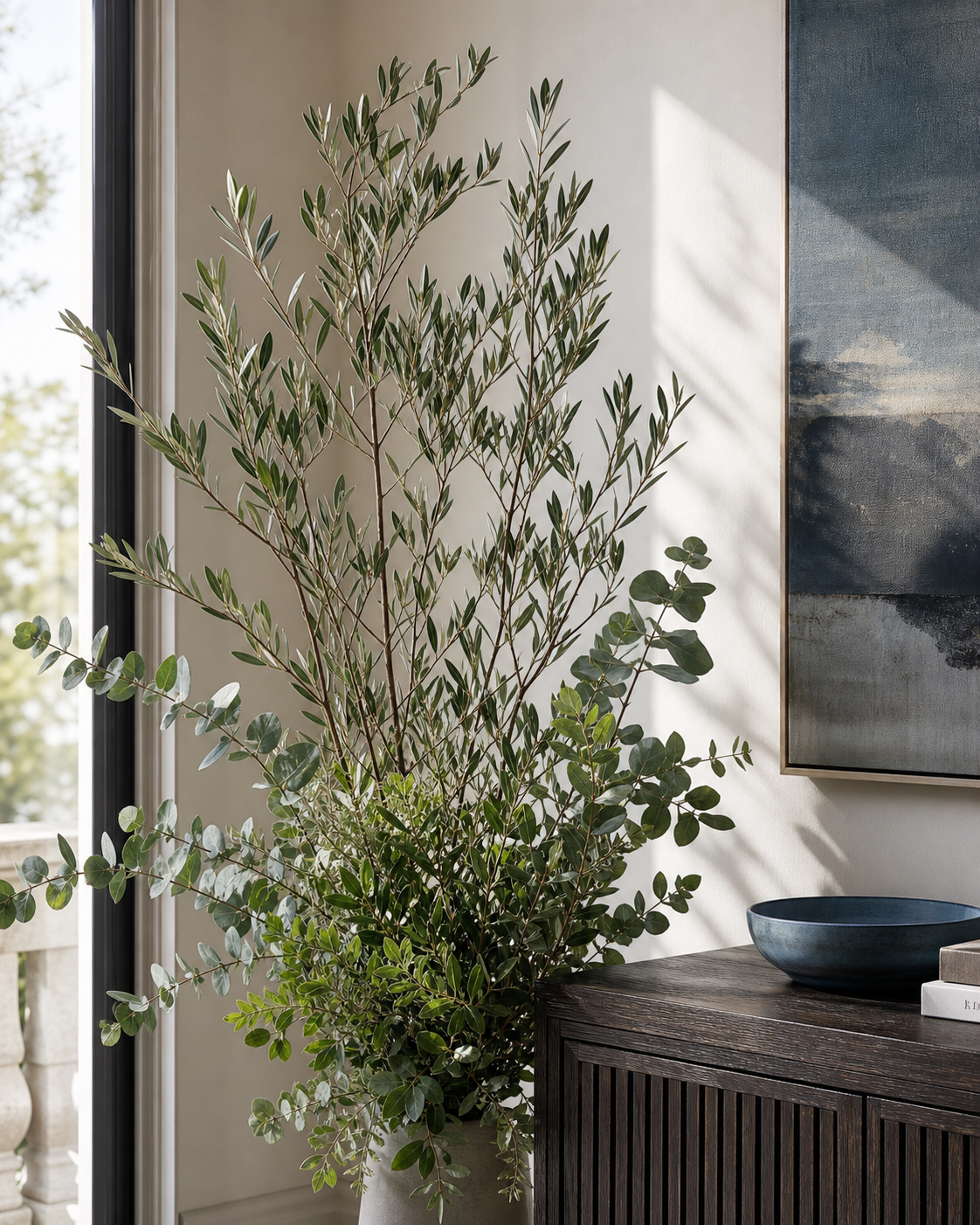
Silver dollar eucalyptus, with its round coin-shaped leaves, is the most recognisable variety and the one that photographs best. The blue-green tone sits well against rust and brown without competing.
Fresh eucalyptus is the classic false economy of autumn styling. It looks superb for about two weeks, then the leaves curl inward and the colour shifts from blue-green to a dull grey-brown. Since the colour is the entire reason people buy it, that is a short return.
3. Berry branches, for the texture
Clustered berries on bare woody stems do something neither flowers nor foliage can: they add texture at the outer edge of the arrangement without adding bulk. A few berry branches pushed through the back of a mums-and-eucalyptus arrangement lift it from tidy to considered.
They are also the element that reads most clearly as autumn. Mums can be spring flowers in the right colour; berries cannot be anything else.
4. Pampas, if the room is modern
This one is optional and depends on the interior. In a warm, traditional room, pampas can look out of place. In a pared-back modern space, a few plumes of faux pampas grass in black or grey give an autumn arrangement a contemporary edge that mums and berries alone do not.
Black pampas in particular works well against rust-toned mums — the contrast is sharp without being loud.
Building the arrangement
The method matters more than the stems. A well-built arrangement of ordinary components beats a badly built one of expensive stems.
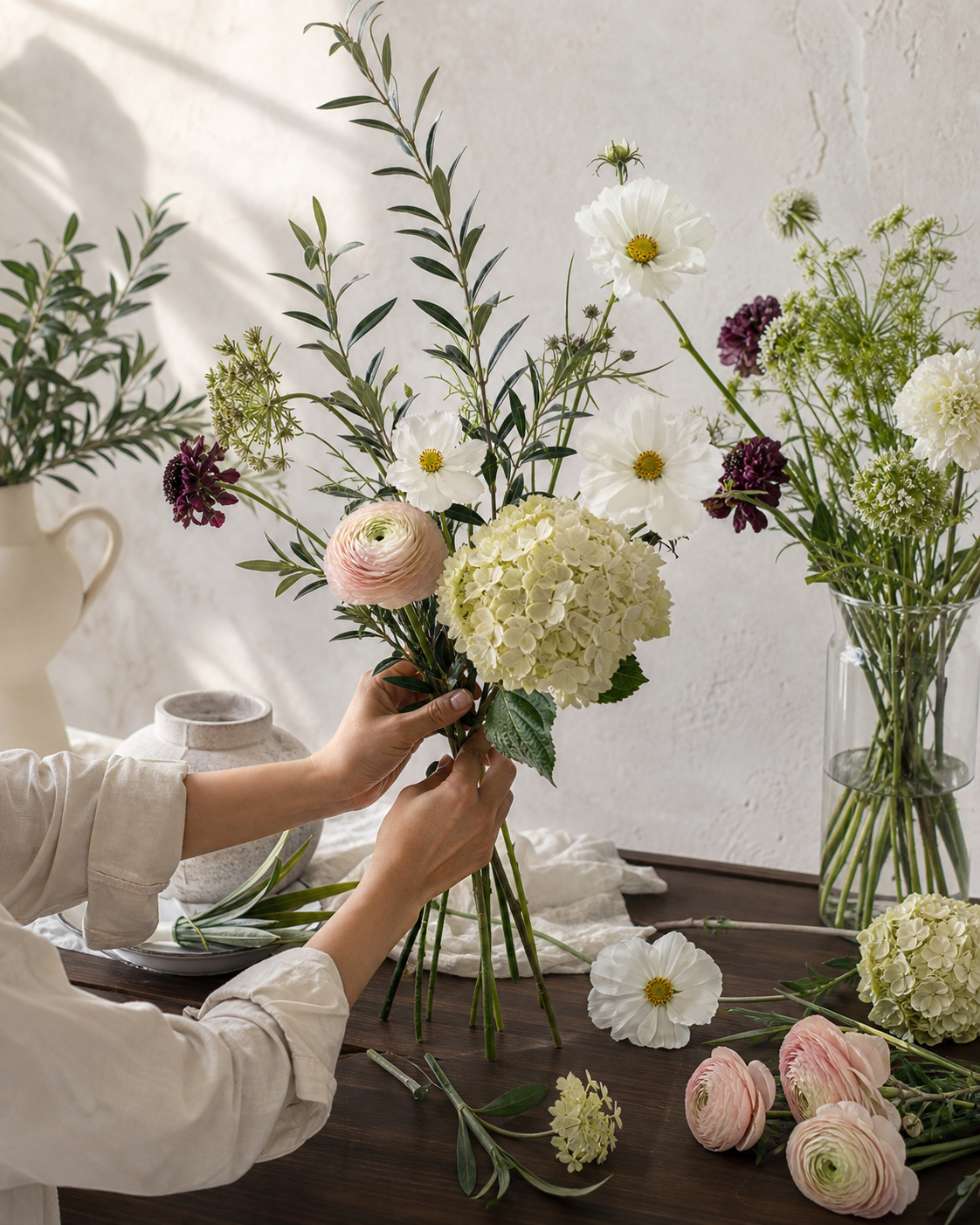
Work in three layers
Base layer — foliage. Place your eucalyptus first, before any flowers. Fan the stems so they lean outward against the rim of the vase, not straight up. This creates the framework that holds everything else in position. In a fresh arrangement this is what the florist calls the mechanics; in a faux arrangement the wired stems do the job on their own.
Middle layer — the mass. Add mums into the gaps the foliage created. Vary the height: some heads sitting just above the vase rim, some reaching to the full height of the arrangement. Flowers all at one level is the single most common mistake and the one that reads instantly as amateur.
Top layer — texture. Berry branches and any pampas go in last, pushed through from the back and angled outward. These should sit higher and wider than everything else.
Get the proportions right
The standard florist ratio is that the arrangement should be roughly one and a half times the height of the vase, and about the same again in width. A 10-inch vase wants an arrangement around 15 inches tall.
Most home arrangements fail by being too short and too narrow — people trim stems to fit rather than choosing a vase that suits the stems. With wired faux stems you have an advantage here: you can bend rather than cut, which means you can adjust the spread without losing height.
Choose the vessel for the season
Autumn arrangements suit opaque vases. A clear glass vase shows the stems, which is fine in spring when the stems are green and part of the look. In autumn, when the stems are woody and dark, an opaque ceramic or stoneware vessel is more forgiving and warmer.
Note that vases are usually sold separately from stems and arrangements — worth checking before you order, since product photography almost always shows the arrangement styled in one.
Placement: three arrangements that cover a house
You rarely need more than three.
Dining table. Keep it low — under 14 inches, so people can see across it. A wide, shallow arrangement of mums with a little eucalyptus works better here than anything tall. Browse ready-made arrangements if you would rather not build one.
Console or entryway. This is where height belongs. Tall stems, an opaque vase with weight in the base, and an arrangement that reaches 20 inches or more. It is the first thing anyone sees, and it can afford to be dramatic.
Kitchen island or counter. Small, dense, and out of the way. Five stems in a squat vase. Kitchens are where fresh flowers fail fastest — heat and steam accelerate wilting — so this is the placement where faux earns its keep most obviously.
Colour: what actually works in autumn
Autumn palettes fail when they include too many warm tones at once. Rust, orange, gold, burgundy and brown in a single arrangement becomes muddy.
Pick two warm tones and one neutral. For example:
- Rust and cream, with green foliage — the safest combination, works in almost any interior
- Deep burgundy and brown, with grey pampas — moodier, suits darker rooms
- Orange and yellow, with green — brighter, better in rooms with a lot of natural light
- Black and cream, with eucalyptus — modern, minimal, works where traditional autumn colours would clash
If you are unsure, build around neutral tones and add a single warm accent. That is harder to get wrong than starting with colour.
Transitioning between seasons
The advantage of building with individual stems rather than buying finished arrangements is that autumn becomes a modification rather than a replacement.
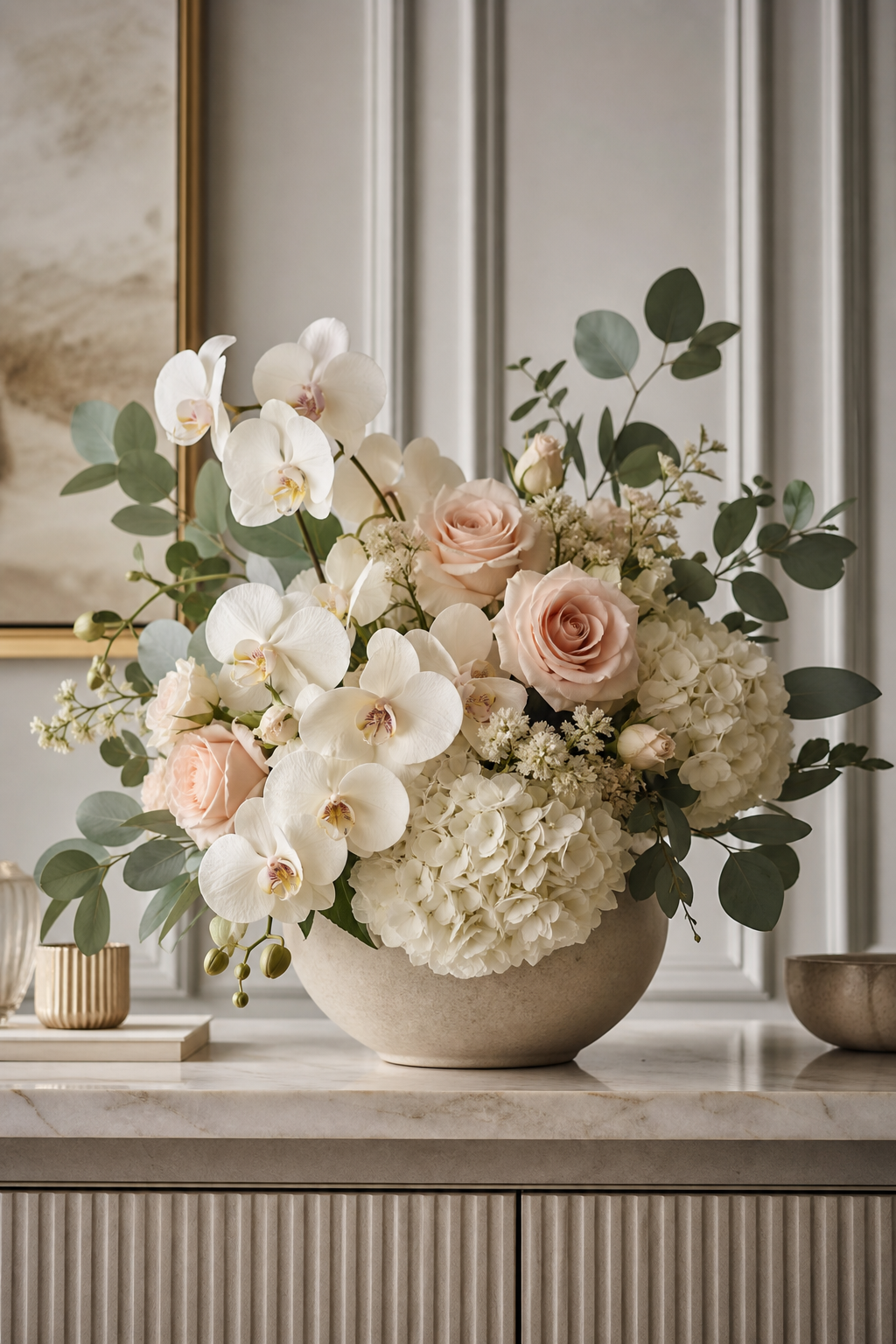
A summer arrangement of white hydrangea and eucalyptus becomes an autumn one by pulling the hydrangea and adding rust mums and berry branches. The eucalyptus stays. In December, pull the mums, keep the berries, add a few white stems, and it reads as winter.
That is three seasons from one set of foliage and three sets of flowers. Our full autumn and winter range is built with that kind of swapping in mind.
Care through the season
Artificial arrangements need almost nothing, but they do collect dust — and autumn, with the heating on and the windows shut, is when dust builds fastest.
Once a fortnight, take the arrangement outside or to a bathroom and go over it with a hairdryer on the cool setting. It takes about a minute and is more effective than wiping, which tends to press dust into the petal folds rather than lift it.
For anything with visible surfaces — eucalyptus leaves in particular — a dry microfibre cloth works. Avoid water on silk petals; it flattens the shape and can leave marks as it dries. Our care guide covers this in more detail.
Storing between years
Do not compress. The most common way faux arrangements are ruined is being packed flat into a box in November and pulled out crushed the following September.
Stand stems upright in a tall box or a spare vase, loosely gathered. If you must lay them flat, put the heaviest heads at the bottom and nothing on top. Pampas plumes in particular do not recover well from long compression, though a shake and a pass with cool air brings back most of the volume.
Stored properly, a good faux autumn arrangement is a purchase you make once and use for five or more seasons — which is the point.
