
Faux Flower Styling
How to Style Pampas Grass in Any Room
Aug
Pampas grass is easy to buy and surprisingly easy to get wrong. The two failure modes are consistent: too many stems packed into too small a vessel, and stems left at the height they arrived. Both are quick to fix.
This is a room-by-room guide to placement, quantity, vessel choice and pairing.
The three rules that fix most arrangements
1. Space between plumes
Pampas needs air around it. The plume shape — that soft, tapering silhouette — only reads when there is background visible between stems. Packed tight, individual plumes merge into a single mass and the effect is lost.
If an arrangement looks heavy or shapeless, the answer is almost always to remove stems, not add them.
2. Vary the height
Stems arrive at a uniform length. Left that way, the plume tops form a flat line across the top of the arrangement, which reads as artificial regardless of quality.
Vary by at least three inches between the tallest and shortest. With faux pampas you can bend the wired stem rather than cutting, which lets you adjust and readjust — useful, because the right height is easier to find by eye than to plan.
3. Odd numbers
Three, five, seven. Even groupings read as symmetrical and static; odd ones read as arranged. It is a florist convention with a genuine visual basis.
Choosing the vessel
The vase matters more with pampas than with most stems, because the stems themselves are long, bare and not attractive.
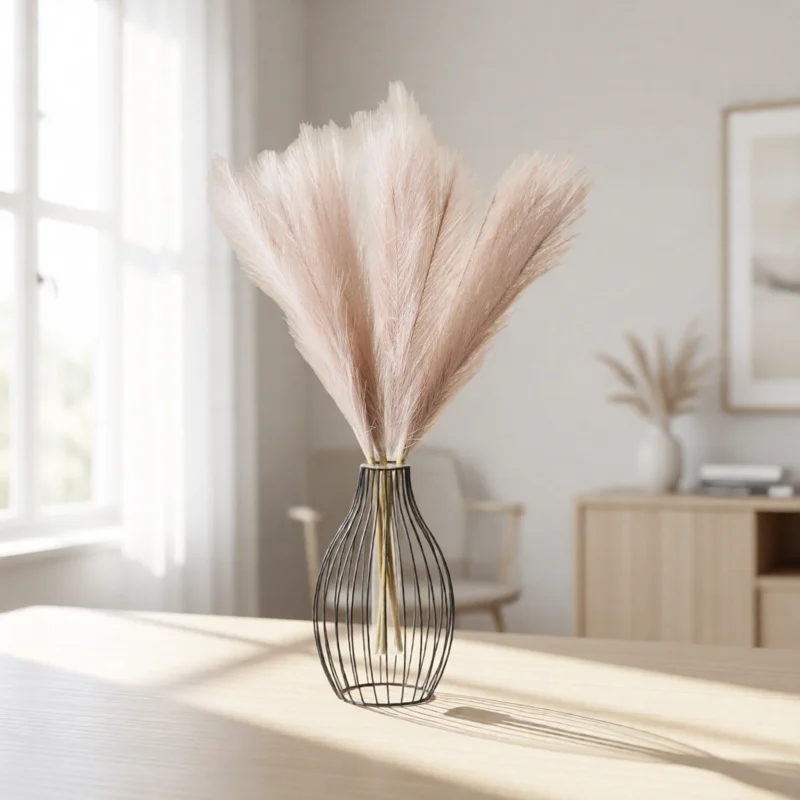
Opaque, always. Clear glass puts bare stems on display, and with artificial stems that is the least convincing part of the arrangement. Ceramic, stoneware, matte glass — anything you cannot see through.
Narrow neck. A narrow opening holds stems in position and stops them splaying. If your vase has a wide mouth, cross the stems at the neck so they brace each other, or use a florist frog in the base.
Weight in the base. Pampas is tall and light, and a tall arrangement in a light vessel tips easily. For floor vases, add sand or pebbles.
Proportion. The arrangement should be roughly one and a half times the height of the vase. A 12-inch vase wants plumes reaching to around 18 inches above the rim.
Room by room
Living room
The standard placement is a floor vase beside a sofa or in a corner, seven to ten stems, reaching four or five feet in total. This is the arrangement that made pampas popular and it still works.
The corner beside a window is the best spot — the plumes catch backlight and the fibre detail shows. The worst spot is directly in front of a window, where the plume becomes a silhouette and loses all texture.
For a mantelpiece or shelf, go much smaller: three stems in a squat vessel, no more than 18 inches total. Mantel arrangements compete with whatever is above them and lose if they are too big.
Entryway
Pampas suits entryways because it reads well from a distance and does not need to be interesting close up. A tall narrow vase on a console, five to seven stems, kept to one side rather than centred — off-centre placement leaves room for keys and post and looks less staged.
Watch the width. Entryways are circulation space, and plumes that spread into the walkway get knocked every time someone passes, which is how stems get bent permanently.
Bedroom
Two smaller arrangements on either side of the bed work better than one large one. Three stems each, in matching vessels, kept low enough not to interfere with lamps.
This is the room where the shedding difference matters most. Dried pampas next to a bed means fibres in the bedding continuously. If the bedroom is the destination, artificial is the sensible choice.
Dining room
Pampas is difficult on a dining table — it is tall, and the plumes shed light debris even in artificial form if the stems are knocked hard. Better placed on a sideboard or in a corner of the room than on the table itself.
If you do want it on the table, keep it under 14 inches so people can see across, and use three stems maximum.
Bathroom
Underrated. Humidity does not affect artificial pampas at all, and the soft texture works against hard bathroom surfaces. Three stems in a small vessel on a windowsill or shelf.
Dried pampas in a bathroom absorbs moisture, droops and eventually develops mould at the base of the plume. This is one placement where artificial is not a preference but a requirement.
Colour
Natural cream is the default and the safest. The other colours each have a specific use.
White — brighter and cleaner than natural cream, better in cool or minimal interiors where the yellow undertone of natural would sit oddly. Our white range covers this.
Black — the strongest contrast option. Works in modern, high-contrast rooms and is very effective against pale walls. Also the most striking pairing with rust-toned autumn flowers.
Pink — soft and warm, popular in bedrooms and nurseries. Note that dried pink fades quickly; artificial holds, which is why most convincing pink pampas is faux.
Grey and slate — a quieter alternative to natural cream, useful in rooms already carrying a lot of warm wood where more cream would be too much.
Mixing colours generally does not work. Pampas is a textural element, and two colours in one vessel fight rather than complement. If you want variation, use separate arrangements in the same room.
What to pair it with
Pampas works alone, which is unusual. But three pairings are reliable:
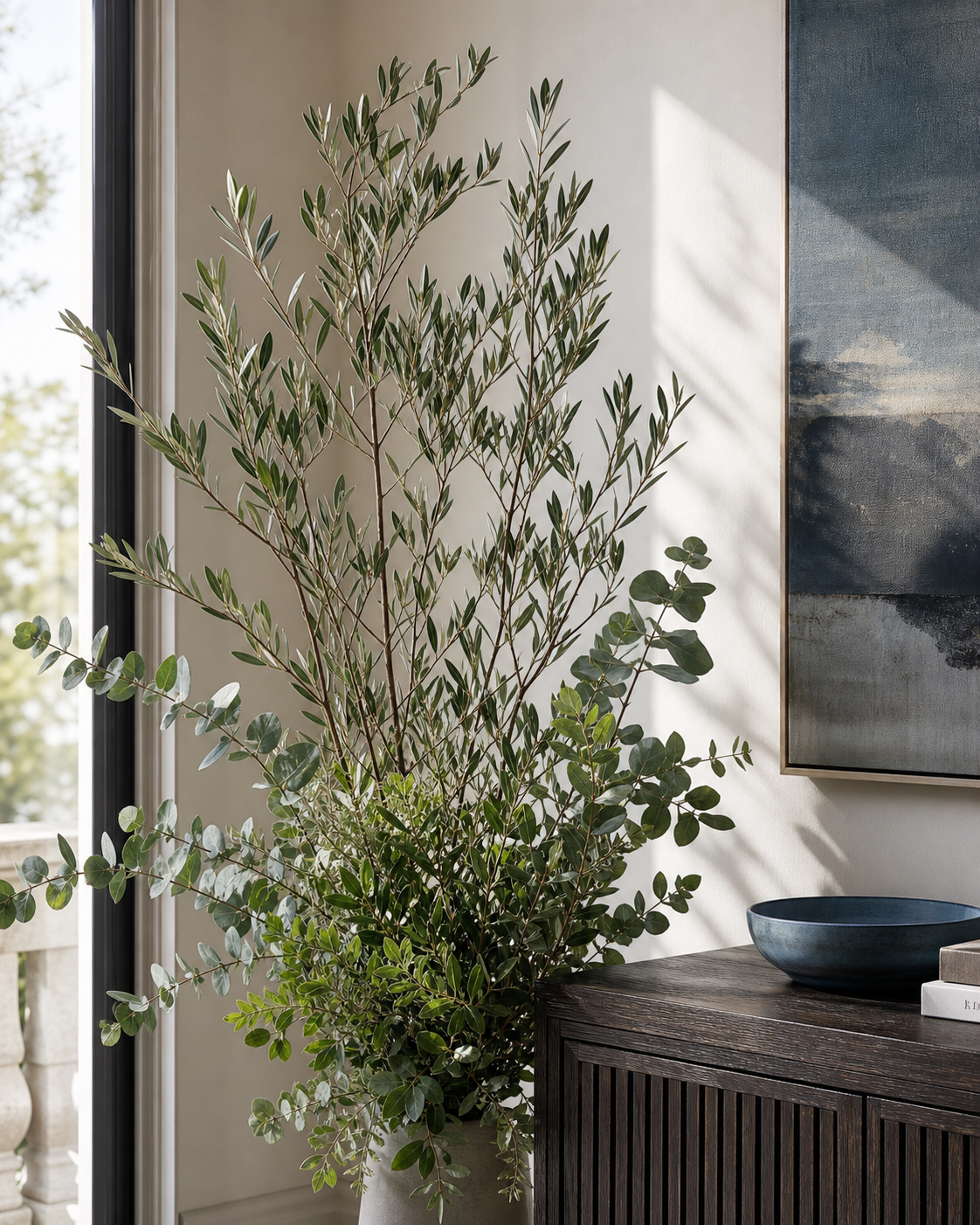
With eucalyptus. The round leaf against the feathered plume is a strong contrast of shape, and the blue-green cools the warm cream. Put the eucalyptus in first as a base layer, pampas through it.
With dried-look stems. Bunny tails, wheat, palm spear — the whole neutral dried palette. This is the boho arrangement and it works because everything shares a texture family.
With a single strong flower. Three pampas plumes and three mums in a deep colour. The plumes give height and softness, the flowers give a focal point. Keep it to two elements — adding a third makes it busy.
What does not work: pampas with delicate small-flowered stems. The scale mismatch makes both look wrong.
Fixing a flat plume
Faux pampas ships compressed and arrives looking thin. This is normal and reversible, and it is worth knowing before you decide the order was a mistake.
Hold the stem near the base and run your fingers up through the plume against the direction of the fibres. Repeat several times, rotating the stem. The plume opens out within a minute.
For stubborn stems, hold them briefly in steam from a kettle — a few seconds, not close enough to wet them — then shake and finger-fluff. The heat relaxes the fibres and they spring back.
Keeping it looking right
Pampas collects dust in the plume, and because the plume is dense, it is not obvious until it has built up enough to grey the colour.
Every couple of months, take the stems outside or to a bathroom and pass a hairdryer on the cool setting over them from about a foot away. This lifts the dust out and re-fluffs the plume at the same time.
Never use water, polish or fabric spray. Anything that leaves a residue makes the fibres tacky, and tacky fibres collect dust faster than clean ones. Full method in our care guide.
Storage
If you rotate arrangements seasonally, store pampas standing upright — a tall box, or simply a spare vase in a cupboard.
Flat storage under other items is the one thing that causes lasting damage. A plume compressed for six months does not fully recover, even with steam.
If you are still deciding between dried and artificial, our comparison of faux and dried pampas covers shedding, colour retention and cost in detail.
