
Buying Guides
Faux vs Dried Pampas Grass: Which Should You Buy?
Aug
Pampas grass went from unfashionable to unavoidable in about three years, and most people bought dried. A good proportion of those people are now looking for faux, for one specific reason: the shedding.
This compares dried and artificial pampas grass on the things that actually determine whether you keep it — shedding, colour, lifespan, allergies and cost.
What dried pampas grass really is
Dried pampas is Cortaderia selloana, harvested at the point the plume opens and then air-dried. It is a genuine plant, not a preserved or treated one in most cases, and that matters for how it behaves indoors.
A pampas plume is thousands of tiny seed-bearing fibres attached to a central spine. Drying does not change that structure — it just removes the moisture. The fibres stay attached exactly as well as they were on the day it was cut, which is to say, loosely.
The shedding problem
This is the single reason most people switch, so it is worth being precise about it.
Dried pampas sheds continuously from the day you unpack it. Not in a burst that settles down, but steadily, for as long as it is in the room. Every draught, every time someone walks past, every time the heating cycles on, more fibres come loose.
The fibres are light enough to travel. People find them on windowsills across the room, in the kitchen, on clothing. They do not sweep up easily because they lift on the air current the brush creates.
Hairspray is the usual internet remedy. It works partially and briefly, at the cost of making the plume slightly stiff and tacky, which then attracts dust. It also has to be reapplied.
Faux pampas does not shed at all. The plume fibres are attached to the stem rather than resting on it. This is the entire practical difference and for many households it settles the question on its own.
Colour over time
Dried pampas arrives in natural cream or wheat and yellows from there. Under normal indoor light it noticeably shifts within a season; in a sunny window it can go quite yellow within a couple of months.
Bleached and dyed dried pampas — the white, pink, black and grey versions — fade faster, because the dye is sitting on already-dead plant fibre with nothing to hold it. Pink in particular tends to go a dull beige.
Artificial pampas holds colour indefinitely indoors. In direct, prolonged sunlight any dyed material lightens eventually, but the timescale is years rather than months. This is why pink, black and grey are far more common in faux than dried — those colours only stay convincing if they hold.
Allergies and dust
Dried pampas is dried plant material carrying seed heads. For people with grass pollen sensitivity it is a genuine irritant, and a large arrangement in a bedroom is a bad idea for a hay fever sufferer.
It also cannot be cleaned. Dust settles into the plume and there is no way to remove it — any attempt causes more shedding. Over a year a dried plume accumulates a visible grey cast that is dust, not fading.
Faux pampas is polyester. It carries no pollen and no seeds, and it can be cleaned: a hairdryer on cool from a foot away lifts dust out of the plume in seconds, and the plume recovers its shape afterwards.
Lifespan
Dried pampas realistically holds up for one season in good condition, maybe two if it is somewhere still and shaded. Past that it is thinner, yellower and dustier than when you bought it, and the shedding has distributed a fair amount of it around the room.
Artificial pampas holds indefinitely with occasional cleaning. Stored upright between uses, it goes on for years.
The cost comparison follows from that. Dried is cheaper per stem; artificial is cheaper past the first replacement.
Where dried genuinely wins
Two things.
Texture up close. A dried plume has an irregularity that artificial cannot fully match. Fibres of slightly different lengths, a slightly uneven spine, the way it catches light. At arm’s length the difference is visible to anyone looking for it.
Weight and movement. Dried plumes are lighter and move more in a draught. Some people specifically want that.
If pampas is going somewhere it will be seen up close and rarely disturbed — a guest room, a shelf in a still corner — dried has a case. If it is in a hallway, a living room, a room with children or pets, or anywhere with a draught, it will shed and you will regret it.
How to tell good faux pampas from bad
Quality varies more here than in almost any other artificial stem, because the plume is difficult to make convincingly.
Fibre density. Cheap versions are sparse — you can see the central spine through the plume. A good plume is dense enough that the spine is hidden.
Fibre length variation. Real plumes taper and the fibres are uneven. Uniform fibre length reads as artificial immediately.
Matte finish. Any sheen is wrong. Real pampas is completely matte.
A bendable stem. Pampas stems in nature curve. A rigid straight stem in a vase looks wrong regardless of plume quality.
The flat plume problem
Faux pampas arrives compressed — it has to, to ship. Out of the packaging it looks thin and disappointing, and this is the most common cause of returns.
It recovers. Hold the stem and run your fingers up through the plume against the direction of the fibres, several times. Or pass it briefly through steam from a kettle, then shake. Either method restores the full volume within a minute or two.
This is worth knowing before you unbox, because the instinct on seeing a flat plume is to assume it is faulty.
Choosing
Choose dried for a still corner, a short-term styling project, or if the natural texture matters more to you than the shedding. Accept that it is a one-season purchase and put it somewhere you do not mind sweeping.
Choose artificial for a main room, anywhere with a draught, anywhere with children or pets, if anyone in the house has hay fever, if you want a colour other than natural cream, or if you want it to still look right next year.
Our faux pampas range covers natural cream, white, black, grey and pink, in three and five stem packs.
How many stems
The most common mistake is buying too few and packing them tight to compensate. Pampas reads best with visible space between plumes.
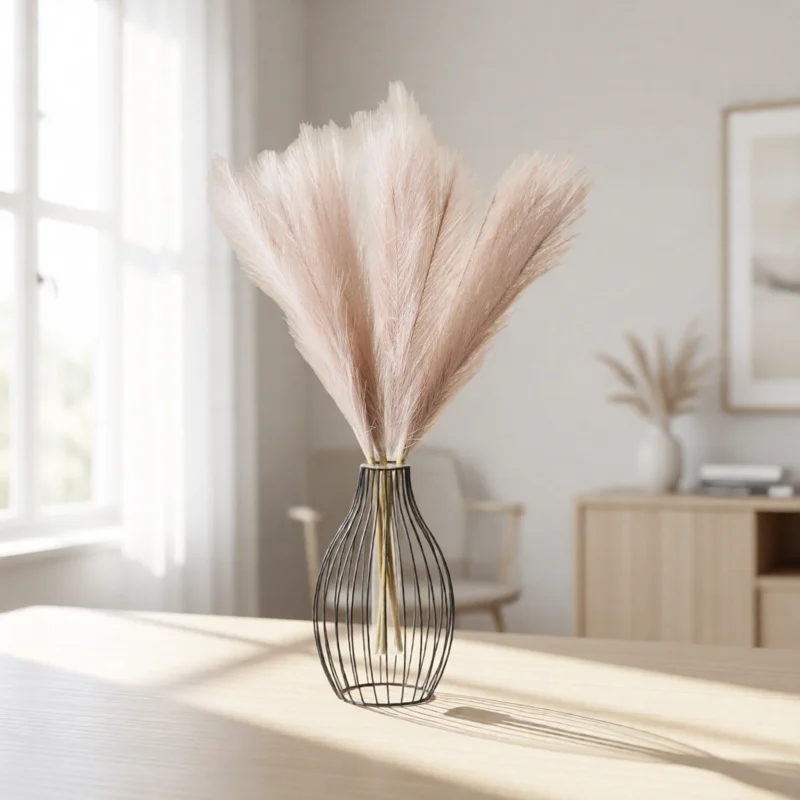
- Narrow-necked vase, 8–10 inches: three stems
- Wide-mouthed vase: five to seven
- Floor vase, 20 inches or more: seven to ten, with a weighted base
Buy in odd numbers. It is a florist convention with a real basis: odd groupings read as arranged, even ones as symmetrical and static.
Care
Every couple of months, take the stems out and pass a hairdryer on the cool setting over them from about a foot away. Dust lifts out and the plume re-fluffs at the same time.
Do not wash, and do not use furniture polish or fabric spray — anything that leaves a residue makes the plume tacky and it collects dust faster afterwards. Our care guide has the full method.
Store upright between seasons. Compression is the one thing that does lasting damage, and a plume stored flat under other boxes for six months does not fully recover.
Once you have chosen, our guide to styling pampas grass by room covers placement, vessel choice and what to pair it with.
