
Buying Guides
Best Artificial Flowers That Look Real: A Buying Guide
Aug
Most advice on buying artificial flowers is a list of shops. This is not that. It is what separates a stem that passes for real from one that reads as plastic from across the room — which is the only thing that actually matters.
Once you know the four signals, you can judge any product photograph in about five seconds.
The four things that determine quality
1. Finish: matte, never glossy
This is the single clearest signal, and it is visible in a photograph.
Real petals and leaves are matte. Some have a faint waxy bloom, but none of them shine. Cheap artificial flowers are moulded from glossy plastic or coated fabric, and the shine catches light in a way nothing in nature does. It is why a bad artificial flower looks wrong before you can say why.
When you look at product images, check the highlights. If there are bright specular points on the petals — small white reflections — the finish is glossy. Good stems have soft, diffuse shading instead.
2. Petal construction: cut and layered, not moulded
Look at a flower head from the side.
A quality flower has individually cut petals layered over each other. They cast small shadows on the petals beneath, and the edges are slightly irregular. A cheap one is a single moulded piece with petal shapes pressed into it — no layering, no shadows, and the edges are all identical.
This is why the side view matters more than the front view. From directly above, a moulded head can look convincing. From the side it flattens out immediately.
3. Colour: variation within the head
No real flower is one flat colour. Petals are lighter toward the base, darker at the edges, or shaded unevenly across the head.
Cheap artificial flowers are dyed a single uniform colour. Good ones are printed or dip-dyed with gradation — often subtle, but it is what makes the head read as three-dimensional rather than as a coloured shape.
Look particularly at where petals meet the centre. That is where real flowers show the most colour change and where cheap reproductions show none.
4. Stems: wired, not rigid
This is the one people skip and then regret.
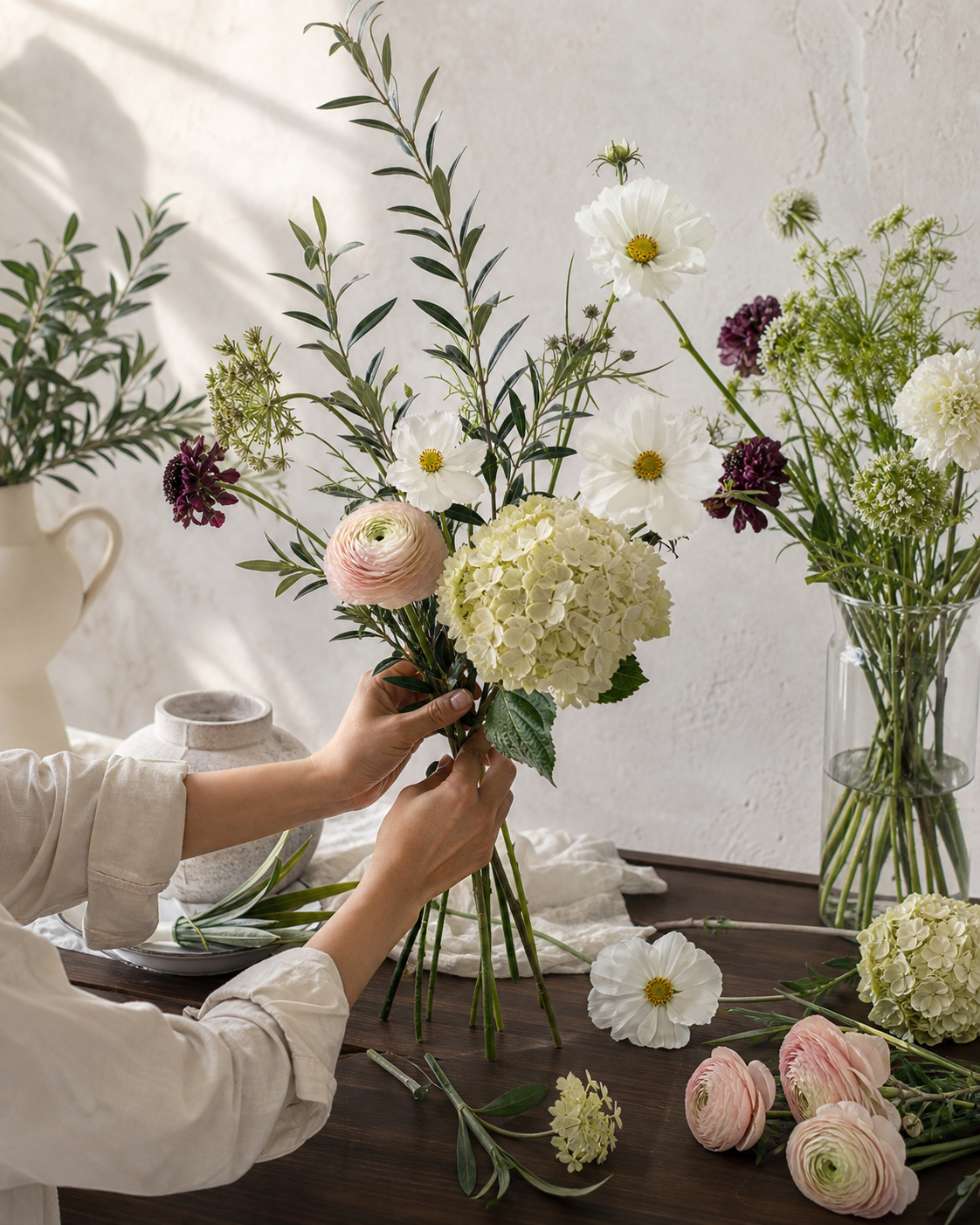
A wired stem bends and holds the bend. That lets you adjust the spread of an arrangement, angle heads toward the light, and trim to height with wire cutters. A rigid moulded stem stays exactly as it came, which means every arrangement you build with it will have that same straight, upright, artificial posture.
Wired stems are also the reason a faux arrangement can be rebuilt seasonally rather than replaced. It is the difference between stems you own and an arrangement you own.
Which flowers convert best to artificial
Some flowers reproduce far more convincingly than others. This is worth knowing because it determines where to spend.
Convert very well
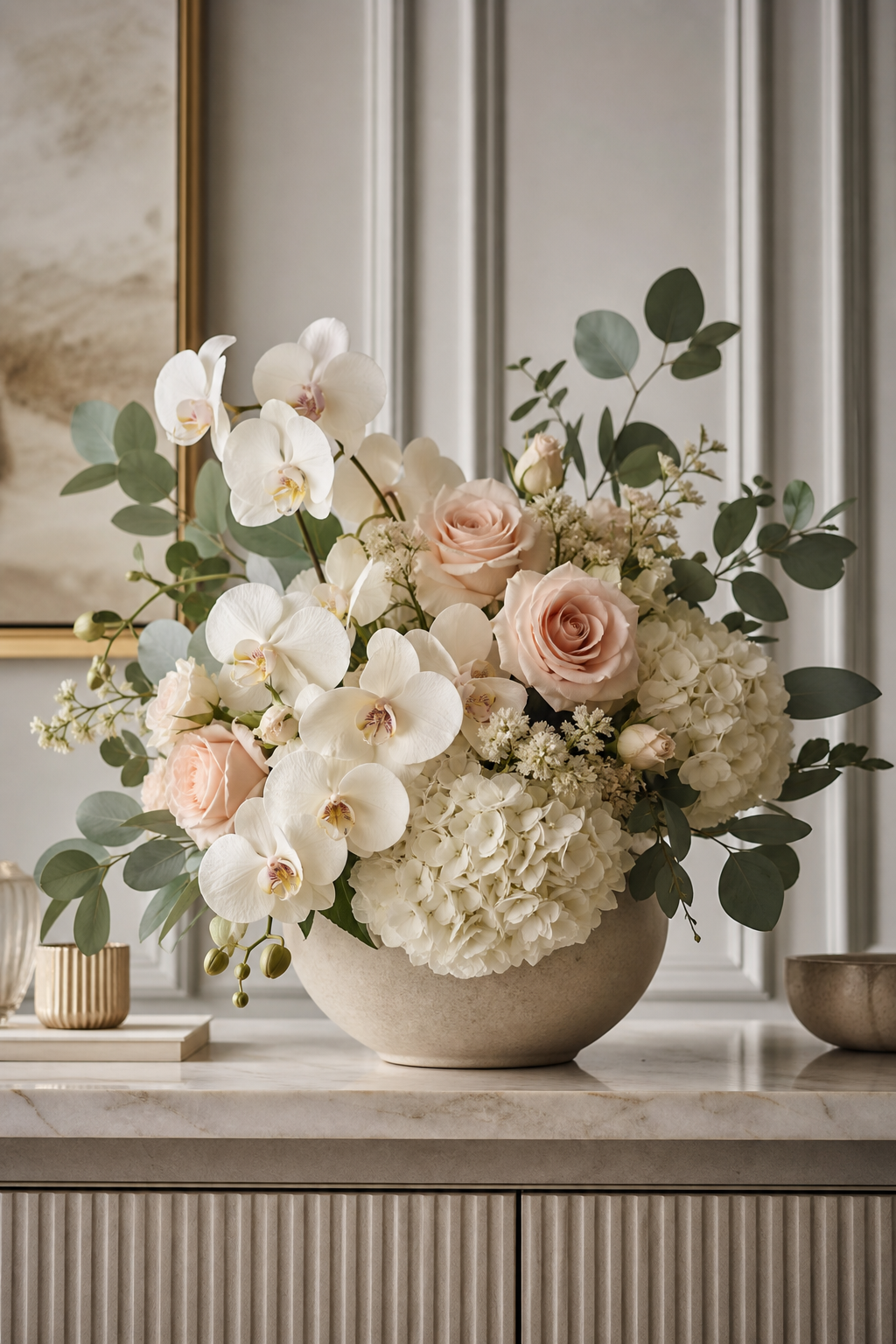
Hydrangea — dozens of small florets in a domed head. The complexity hides imperfections, and no single floret needs to be perfect. Also the flower that benefits most from being artificial, since fresh hydrangea wilts within hours out of water.
Mums — dense pom-pom heads of many short petals. Same principle: the density does the work. And real mums shed heavily, which artificial does not.
Pampas grass — the plume is thousands of fine fibres. Artificial versions are genuinely difficult to distinguish, and they do not shed, which dried pampas does constantly.
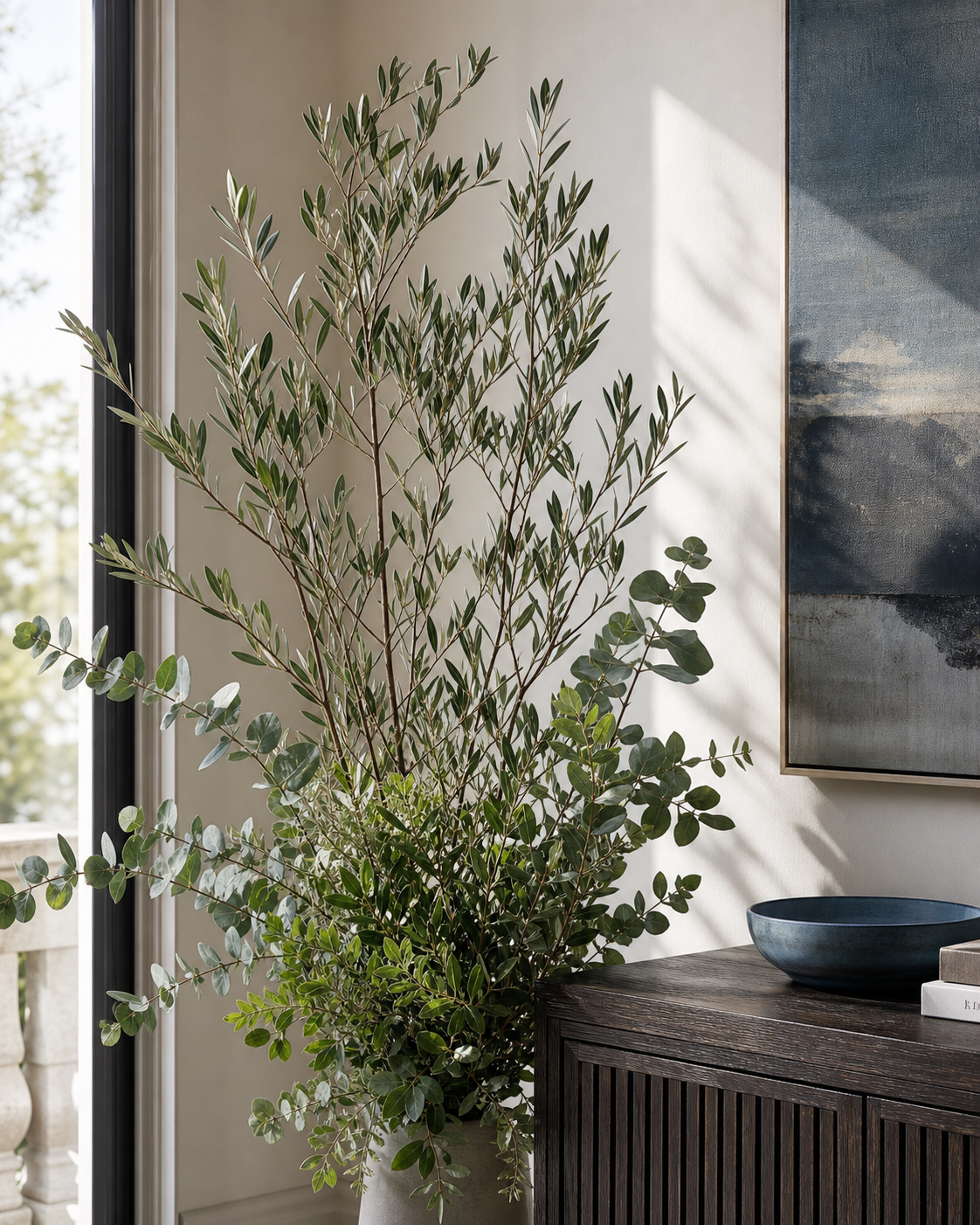
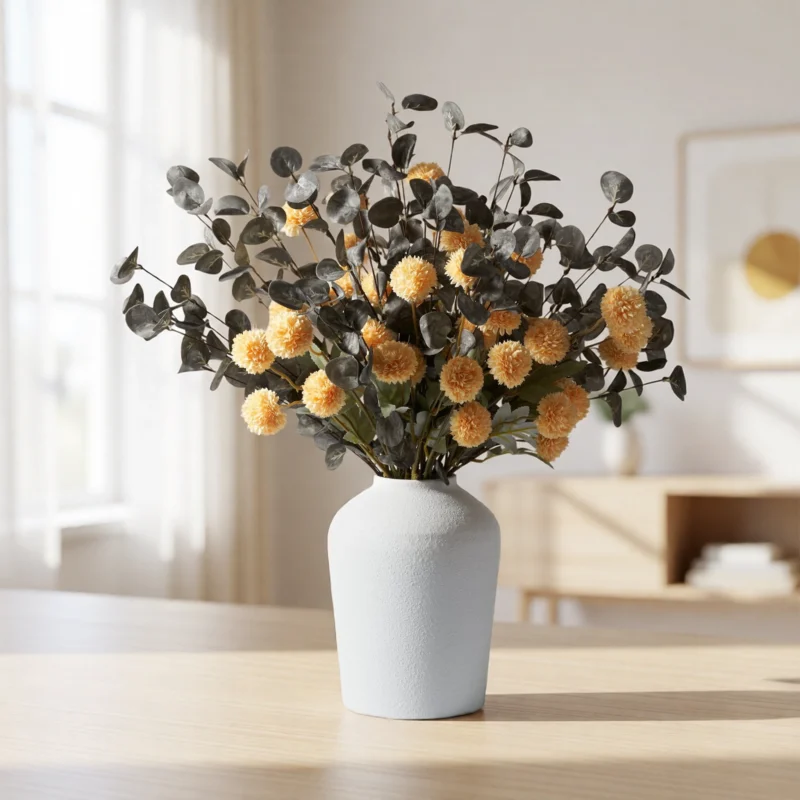
Eucalyptus — flat matte leaves are straightforward to reproduce. And fresh eucalyptus curls and greys in two weeks, so the artificial version arguably looks more like eucalyptus than two-week-old eucalyptus does.
Convert less well
Tulips — a smooth, simple, waxy petal with nowhere to hide a flaw. Also translucent at the edges, which artificial materials struggle with.
Lilies — large flat petals with visible veining and prominent stamens. Every element has to be right.
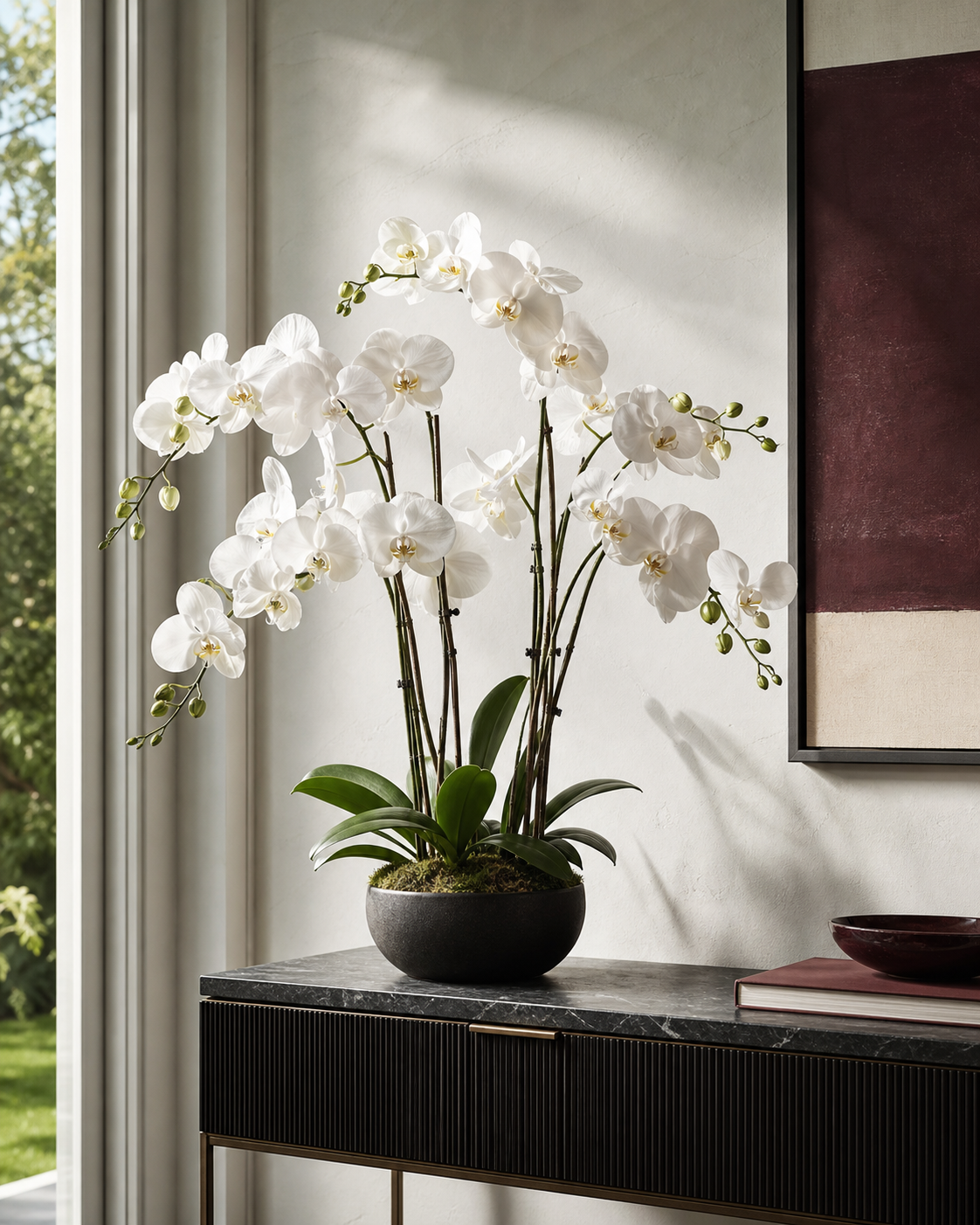
Orchids — the surface has a particular sheen that reads as either too matte or too glossy in reproduction.
None of these are impossible, but they need to be very good to work, whereas a mid-range hydrangea passes easily.
Where the money should go
A useful rule: spend on the flowers that carry the arrangement, save on the ones that fill it.
An arrangement has focal flowers — the ones the eye goes to — and supporting stems. Focal flowers are inspected. Supporting stems are not. Buy the best focal flowers you can and use mid-range filler around them, and the whole arrangement reads better than if you spread the same budget evenly.
Concretely: good hydrangea or roses at the centre, ordinary eucalyptus and wax flower around them.
Five mistakes that undo good stems
Clear glass vases
Artificial stems are the least convincing part of any artificial arrangement. Clear glass puts them on display. Use opaque vessels and the problem disappears entirely.
If you must use clear glass, the usual solution is a filler — pebbles, sand, or moss at the base to hide the stem ends.
Everything at one height
Stems arrive at a uniform length. Left that way, the heads sit in a flat plane across the top, which nothing in nature does. Vary by at least three inches.
Too many stems
The instinct is to fill the vase. Real arrangements have gaps — you can see through them in places. Packed arrangements read as artificial even when every individual stem is excellent.
Perfect symmetry
Real arrangements lean. One side is slightly fuller. Some heads face away. Building a perfectly balanced arrangement is the fastest way to make good stems look fake.
Never cleaning them
Dust is what eventually gives artificial flowers away. A dusty silk petal loses its colour depth and takes on a grey cast. Every month or two, a hairdryer on cool from a foot away is enough. Our care guide covers the method for different materials.
What to check before buying
Look at the side view. If a listing only shows the flower from the front, that is often deliberate. Side views reveal moulded heads.
Check for stated stem count and height. Vague listings usually mean disappointing quantity. Specific numbers are a good sign.
Check whether a vase is included. Almost always it is not — the vase in the photograph is styling. This is the most common cause of disappointment on delivery, and it is worth reading the description rather than assuming.
Buy one before buying twelve. If you are furnishing a room or an event, order a single stem first and look at it in your own light. Showroom and photography lighting flatters everything.
Realistic expectations
Good artificial flowers are convincing at conversational distance — roughly three feet and beyond. At that range, quality stems in a well-built arrangement are not identifiable as artificial by most people.
At arm’s length, someone looking carefully will usually be able to tell, most often from the stem rather than the flower. That is worth knowing so you can place accordingly: a console table across a room is a better placement than a desk you sit at.
What artificial flowers cannot do is smell. There is no scent, and no reliable way to add one. If the smell of fresh flowers is a large part of why you buy them, artificial will not replace that — though many people keep a small number of scented fresh stems alongside artificial arrangements for exactly this reason.
Where to start
If you are buying artificial flowers for the first time, start with one arrangement in one room rather than doing a whole house at once. Live with it for a fortnight. You will learn more about what you actually want from that than from any amount of browsing.
The easiest first purchase is a ready-made arrangement — already balanced and proportioned, so nothing depends on your arranging. Once you know what you like, individual stems give you far more control and let you rebuild seasonally rather than buying again.
