
Buying Guides
Silver Dollar Eucalyptus: Real vs Dried vs Faux
Aug
Silver dollar eucalyptus is the most requested foliage in interior styling, and the one people most often regret buying fresh. The round, coin-shaped leaves and blue-green colour are the whole appeal — and both are gone within about a fortnight.
This is a straight comparison of real, dried and artificial silver dollar eucalyptus: what each actually does over time, what it costs across a year, and which is right for what.
What silver dollar eucalyptus actually is
Eucalyptus cinerea is the botanical name, and it is the variety most florists mean when they say eucalyptus without qualifying it. The common name comes from the leaf shape: round, flat and roughly coin-sized, set closely in opposing pairs along a pale stem.
You will occasionally see it sold as argyle apple, which is the same plant. Other eucalyptus varieties used in floristry — seeded, baby blue, willow, parvifolia — have narrower or more scattered leaves and read quite differently in an arrangement.
If a product is listed simply as cinerea, that is the same thing described by its species name rather than its common one. Almost nobody searches for it that way, which is worth knowing if you are trying to find it.
Fresh: two good weeks
Cut silver dollar eucalyptus arrives at its best and declines from there.
Days 1–10. The blue-green bloom on the leaf surface is intact, the leaves are flat and full, and the stems have enough water to hold their shape. This is the look people buy it for.
Days 10–18. Leaves begin to curl inward at the edges. The waxy bloom rubs off wherever the stems have been handled, leaving patches of duller green. The colour starts shifting from blue-green toward grey.
Day 18 onward. Fully curled, colour gone to grey-brown, stems brittle. Technically it has dried rather than died, which is why people often leave it — but at that point it is a different product with a different look.
Two things accelerate the decline. Central heating dries the stems faster than they can draw water, which is why a bunch that lasts three weeks in spring gets ten days in November. And handling removes the bloom permanently — every time you rearrange it, you take some of the colour off.
Dried: permanent, but grey
Dried eucalyptus is fresh eucalyptus allowed to complete the process, often with glycerine to keep the leaves supple rather than brittle.
It lasts indefinitely and has a genuine, papery texture that artificial cannot fully replicate up close. But the colour is settled grey-green or brown-green, not the blue-green of fresh. If the blue tone was why you wanted it, dried does not deliver.
Glycerined stems also stay slightly tacky and attract dust, and they cannot be cleaned — water marks them permanently.
Artificial: the colour, held
The argument for faux silver dollar eucalyptus is narrow and specific: it holds the blue-green colour and the flat leaf shape permanently.
Quality varies significantly, and there are three things that separate convincing stems from obvious ones.
Leaf finish. Real silver dollar leaves are matte, with a faint powdery bloom. Cheap artificial versions are glossy, which is the single clearest giveaway — plastic shine reads as fake from across a room. Look for a matte or lightly powdered finish.
Leaf spacing and size variation. On a real stem, leaves get smaller toward the tip and the pairs are not perfectly even. Moulded stems with identical leaves at identical spacing look wrong even when people cannot articulate why.
Stem construction. A wired stem can be bent into a natural curve and holds it. A rigid moulded stem stays straight, and straight stems in a vase look artificial regardless of how good the leaves are. Wired stems can also be trimmed to height with wire cutters.
Our eucalyptus stems are silk with wired cores, in green, white-green and ivory tones, sold both as individual stems and in finished arrangements.
Cost across a year
The per-bunch price of fresh eucalyptus is low, which is why the comparison is misleading if you stop there.
Keeping fresh eucalyptus continuously in one room means buying roughly every two weeks — around 26 bunches a year. Even at a modest price per bunch, that is a substantial annual figure, plus 26 trips to buy it.
A set of artificial stems is a single purchase. If it holds for five years, the effective annual cost is the purchase price divided by five, against 26 bunches a year for fresh. The maths only starts to matter past about three months of continuous use, which is exactly the situation most people are actually in.
Where fresh still wins outright: a one-off event, a dinner, a photograph. For a single evening, fresh eucalyptus at its peak is better than any artificial stem and the cost is trivial.
Which to choose
Choose fresh if it is for a specific occasion within the next fortnight, or if the scent matters — the eucalyptus oils are the one thing artificial cannot reproduce at all.
Choose dried if you want a genuine natural texture and the grey-green colour suits the room. Good in neutral, textural interiors. Poor anywhere the blue tone was the point.
Choose artificial if the stems are staying out permanently, if the room is dry or heated, or if the placement is somewhere fresh stems fail quickly — a kitchen, a bathroom, a windowsill in direct sun, or a hallway you do not pass often enough to maintain.
How to arrange it well
Silver dollar eucalyptus is a supporting stem that also works alone, and it needs a different approach for each.
On its own
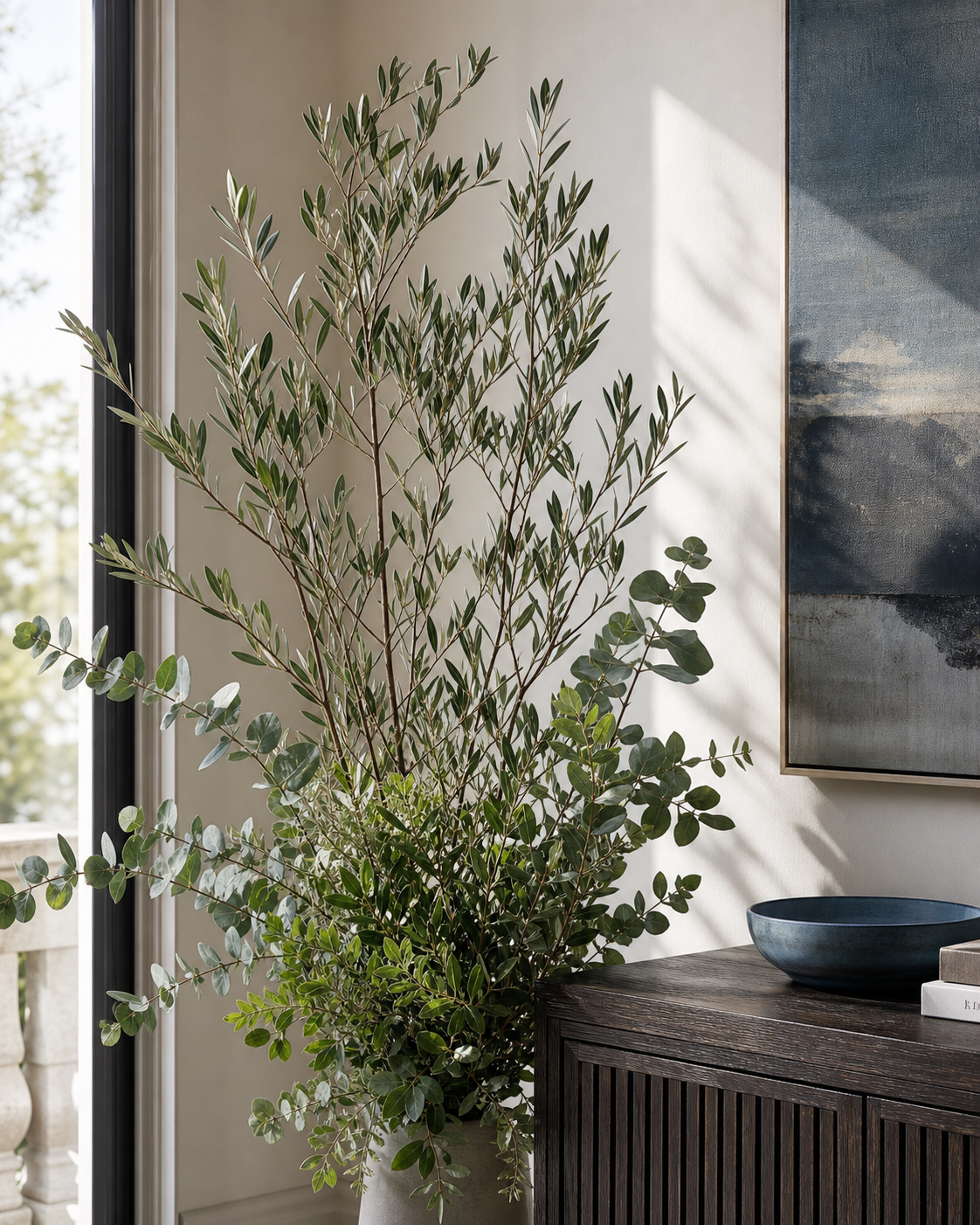
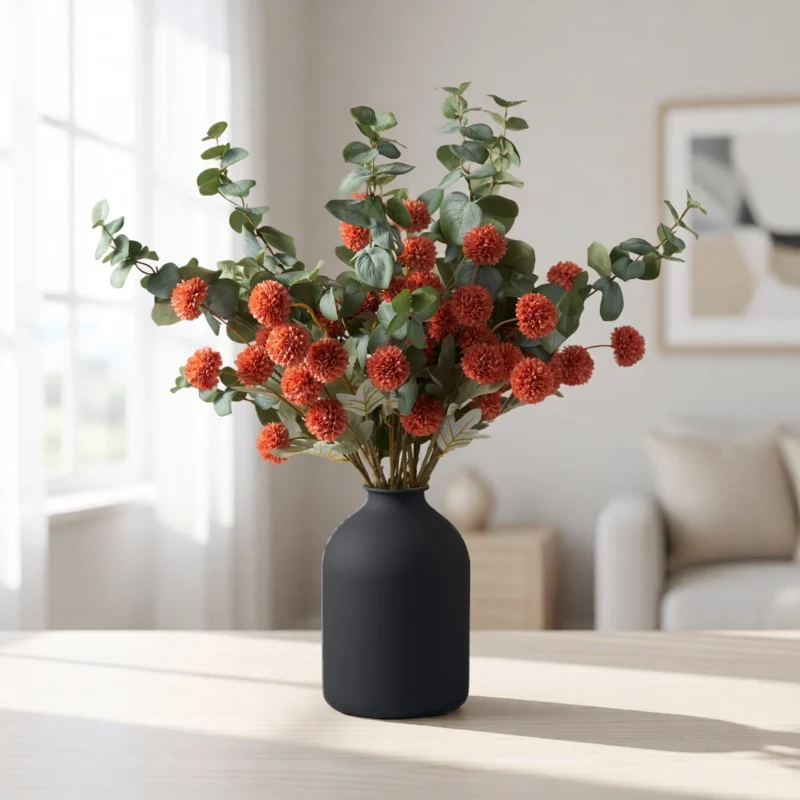
Five to seven stems in a tall opaque vase, nothing else. This is the arrangement that appears in most interiors photography and it works because of restraint.
Fan the stems so they lean outward against the vase rim rather than standing upright. Vary the heights by two or three inches. Turn some stems so the leaves face sideways rather than all presenting flat — real foliage is never uniformly oriented.
As a supporting stem
Eucalyptus goes in before the flowers, not after. Build the foliage framework first, then place flowers into the gaps it creates. This is how florists work and it is the reason professional arrangements hold their shape while home ones slump.
It pairs particularly well with hydrangea — the round leaf and the round flower head echo each other — and with mums in autumn, where the blue-green cools down the rust tones.
Common mistakes
Too many stems is the main one. Eucalyptus needs air around it; packed tight, the individual leaf shape disappears and it reads as a green mass.
Stems all at one height is the second. Cut or bend to at least three different lengths.
Clear glass with artificial stems is the third. Faux stems are the least convincing part of any artificial arrangement, and clear glass puts them on display. Opaque vessels hide them.
Where it works in a house
Bathrooms. Humidity and low light kill most fresh stems quickly. Artificial eucalyptus is unaffected by either, and the spa association makes it a natural fit.
Kitchens. Heat, steam and grease. Fresh foliage struggles; artificial wipes clean.
Entryways. A tall vase of eucalyptus is the standard entryway arrangement because it reads well from a distance and does not need to be interesting up close.
Bedrooms. Worth noting for anyone with hay fever: eucalyptus is not a common allergen, but any fresh plant material carries mould spores in the water. Artificial stems sidestep that entirely.
Care
Dust settles on flat leaves faster than on textured surfaces, so silver dollar eucalyptus needs cleaning more often than most artificial stems — roughly monthly.
A dry microfibre cloth over each leaf works. For a full arrangement, a hairdryer on cool from about a foot away is faster and reaches into the middle where a cloth cannot.
Do not use water or cleaning spray. Silk leaves mark, and the matte finish that makes them convincing is exactly what water damages. Full details are in our care guide.
The short version
Fresh silver dollar eucalyptus gives you about ten good days and then becomes something else. Dried gives you permanence but not the colour. Artificial gives you the colour and the shape indefinitely, provided you buy stems with a matte finish, varied leaf sizing and a wired core.
For a dinner party, buy fresh. For a room, buy artificial.
